Working With the Camera in Real Time — Catch, Pause, Reopen
Mar 28, 2026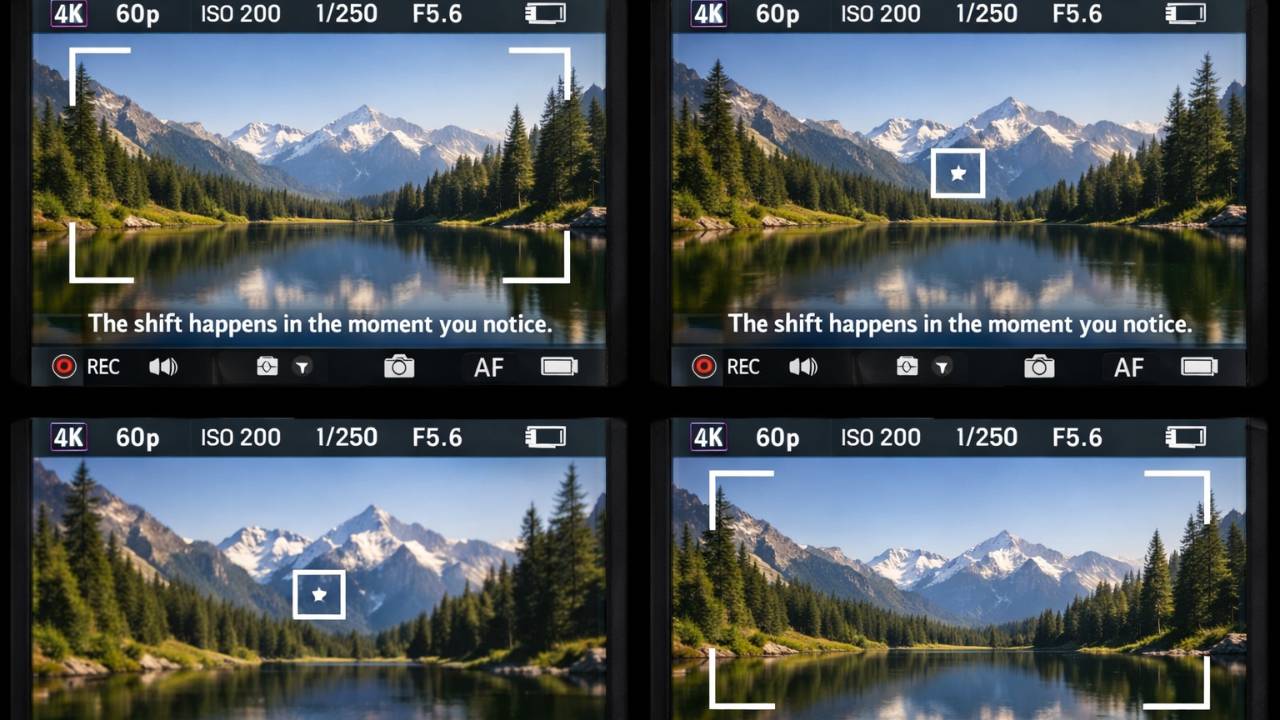
Most people think change is something you do after the moment. After the reaction. After the words. After the silence. After you’ve already tightened, already concluded, already decided what it means. And then, because you’re a thoughtful person, you try to repair it from the outside: you revise your behaviour, you rehearse a better response, you promise yourself you won’t do that next time.
But the real shift rarely happens after the moment. It happens inside it.
In the 3Ps camera model, perception is the lens, perspective is the processing unit, and possibility is the image produced. When you feel stuck, it’s often because the camera has moved into a familiar setting without asking you. The lens narrows. The processing hardens. The image collapses into a small set of outcomes that feel inevitable. And because it happens quickly, it doesn’t feel like a setting. It feels like reality.
So the question isn’t, “How do I become a different person?” The question is, “How do I meet the moment earlier?”
Earlier doesn’t mean you catch it at the first thought. It means you catch it at the first tightening. The first internal speed-up. The first sense of “here we go.” The first urge to defend, to justify, to withdraw, to fix, to perform, to disappear. That is the moment the camera is changing settings.
If you can meet that moment, you don’t have to fight yourself. You don’t have to argue with your own mind. You don’t have to force a better attitude. You simply have to interrupt the automatic sequence long enough to see what it is.
This is where people often misunderstand what I mean by “working with your inner camera.” They assume it’s a technique, a script, a set of steps you must execute perfectly. It isn’t. It’s a relationship with your own meaning-making. It’s the willingness to notice the instant the lens narrows and to treat that narrowing as information, not as instruction.
A narrowing lens is not a failure. It’s a signal.
Sometimes it’s a signal that you’re tired. Sometimes it’s a signal that you’re carrying more than you’ve admitted. Sometimes it’s a signal that you’re in a system that rewards performance and punishes uncertainty. Sometimes it’s a signal that you’re close to something you care about and you don’t want to get it wrong. Sometimes it’s a signal that an old conclusion is trying to take the wheel.
The work is not to eliminate the signal. The work is to stop obeying it automatically.
If you want a simple way to hold this in real time, think of three movements: catch, pause, reopen.
Catch is the moment you notice the setting change. Not the whole story, not the full argument, not the entire emotional weather system—just the shift. The tightening. The certainty. The internal “of course.” Catch is the moment you realise you are no longer looking at the whole scene. You are looking through a narrowed lens.
Pause is not a performance of calm. It’s a refusal to rush. It’s the smallest possible gap between stimulus and response. It might be a breath, a sip of water, a glance away, a slower exhale, a moment of silence you don’t fill. Pause is the space where your processing unit stops pretending it has to decide immediately.
Reopen is the return of choice. It’s the willingness to let in a little more information and to hold more than one meaning at the same time. Reopen doesn’t mean you become endlessly uncertain. It means you stop collapsing the scene into a single verdict before you’ve even seen what else is present.
What does reopening look like in practice? Often it looks like a question that doesn’t demand an answer, only a widening. What am I assuming right now? What am I not letting in? What conclusion am I treating as fact? What else could be true, even if I don’t like it? What do I need that I’m not naming? What would I see if I widened the frame by ten percent?
Notice what these questions do. They don’t tell you what to think. They don’t force positivity. They don’t insist on a better story. They simply loosen the grip of certainty and allow the processing unit to work with more than one meaning.
And then something important happens: the image produced changes. Possibility returns, not as a motivational poster, but as a practical expansion of what you can actually see as a next step. You may still choose the same action, but you choose it from a wider frame. You may still set the same boundary, but you set it without the tightness of a verdict. You may still have the hard conversation, but you enter it with more room inside you.
This is why the goal isn’t to never narrow the lens. The goal is to notice when you do, and to stop mistaking that narrowing for truth. The lens will narrow. The processing will harden. You are human. The difference is whether you catch it early enough to reopen the frame.
And if you don’t catch it early, you haven’t failed. You simply meet it where you can. You can catch it after the sentence. You can pause after the email. You can reopen after the meeting. The work is not perfection. The work is contact.
In the next post, we’ll explore a quieter but more persistent force: the way systems, roles, and repeated environments train the lens over time, so that what feels “personal” is often a learned adaptation to the room you’re in.
- Watch the YouTube series trailer: Architect of the Human Mind [YouTube link ]
- Explore the full webinar journey (a four-part series through the 3Ps):https://www.mindshift202.com/events
- Register for Webinar 2 (April 25, 2026): Understanding Perception:https://us06web.zoom.us/meeting/register/4pMs4z8fRWOW0YtVuWZp7w
- Read the book: Questioning the Walls:https://amzn.eu/d/015xWd2u