Living With a Wider Lens — A Conclusion to the 3Ps Series
Apr 11, 2026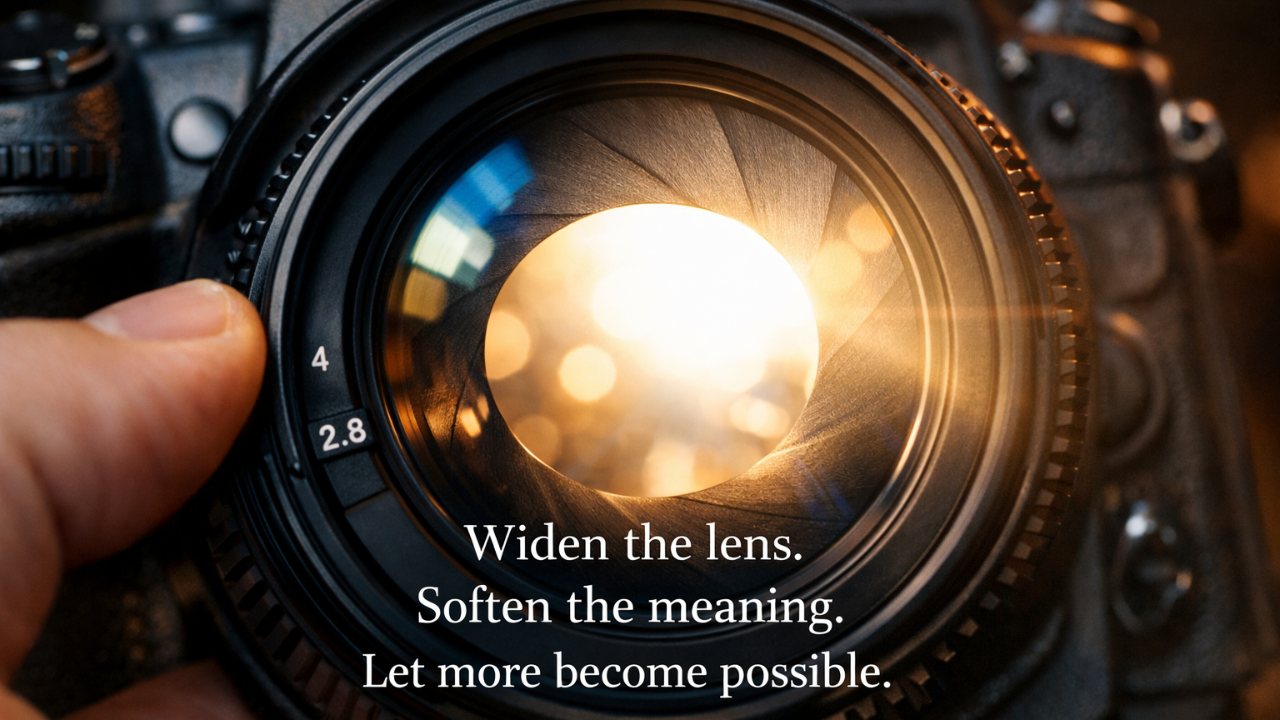
If you’ve followed this series from the beginning, you’ll have noticed something that matters: the 3Ps aren’t a self-improvement project. They’re not a set of steps to perform, or a new way to talk yourself into being fine. They’re a way of seeing what’s already happening, and that’s why they work. When you can see your own meaning-making as it’s being made, you stop being pushed around by it.
Perception is the lens. It’s what gets let in and what gets left out. Perspective is the processing unit. It’s how what you’ve taken in gets organised into meaning. Possibility is the image produced. It’s what you can see, what you can imagine, what you can reach for, and what you quietly rule out before you’ve even begun.
The reason this matters is not because it’s a neat model. It matters because most of what people call “reality” is actually an image produced by a lens and a processing unit that have become familiar. Familiar doesn’t mean wrong. It just means trained. And when something is trained, it can be retrained, not through force, but through contact.
A narrower lens is not a moral failure. It’s often a sign that something is at stake. It can be a sign that you care. It can be a sign that you’re tired. It can be a sign that you’re in a room that rewards certainty and punishes nuance. It can be a sign that an old conclusion is trying to keep you safe. The problem isn’t that the lens narrows. The problem is that the narrowing becomes invisible, and then the image feels like the only truth available.
That’s where perspective does its quiet work. The processing unit is always trying to help. It wants coherence. It wants predictability. It wants to reduce uncertainty quickly enough that you can act. When you’re under pressure, it speeds up. When you’ve been hurt, it becomes vigilant. When you’ve been trained by a particular room, it anticipates the rules before they’re spoken. None of that is wrong. It’s intelligent. It’s adaptive. It’s also the exact reason you can end up living inside a meaning that no longer fits.
This is why labels are so powerful. They feel like clarity, but they often function like locks. They compress a moving scene into a verdict, and once a verdict is in place, the lens starts collecting evidence to support it. The processing unit then turns that evidence into a story that feels increasingly self-evident. The image produced becomes smaller, and possibility shrinks, not because life is cruel, but because your camera is set to a narrow frame.
The work, then, is not to chase possibility like a mood. It’s to work upstream. It’s to meet the lens and the processing unit before the image hardens. It’s to notice the moment you tighten, the moment you rush to conclude, the moment you decide what something means and what it implies about you, about them, about the future. That moment is the hinge. It’s the place where you still have room.
A wider lens doesn’t mean you become endlessly open, endlessly flexible, endlessly available. It doesn’t mean you tolerate what you shouldn’t tolerate. It doesn’t mean you stop making decisions. It means you stop mistaking your first meaning for the whole scene. It means you can hold more than one interpretation long enough to choose your response rather than default to a familiar reaction.
This is where people often expect a dramatic feeling, as though widening the lens should immediately create relief. Sometimes it does. Sometimes it doesn’t. Sometimes widening the lens reveals complexity you’ve been avoiding. Sometimes it reveals a truth you’ve been compressing into a simpler story because the simpler story was easier to carry. Sometimes it reveals that what you’ve been calling a personal flaw is actually a learned adaptation to a room that trained you to survive. Sometimes it reveals that what you’ve been calling “fine” is actually a slow, quiet shrinking.
And still, possibility returns. Not as optimism. Not as forced positivity. Not as a demand to see the bright side. Possibility returns as a more accurate image of what is available when you stop collapsing the scene into a verdict.
This is why the 3Ps matter in leadership and in relationships as much as they matter in private. A leader with a narrow lens will interpret quickly and act quickly, and it will look decisive, but it will also be brittle. A leader with a wider lens can hold uncertainty long enough to see what’s actually happening, and that changes the quality of decisions. A partner with a narrow lens will meet a label, not a person. A partner with a wider lens can stay present long enough to let the moment be more than one meaning.
The same is true internally. When you can see your own lens and your own processing, you stop treating your responses as proof of who you are. You start treating them as information about what you’re carrying, what you’re protecting, what you’ve learned, and what you might be ready to change. That single shift—from verdict to information—softens the processing. And when the processing softens, the lens widens almost by itself.
If there’s one thread I’d want you to hold from this series, it’s this: you don’t need to force a new image. You need to become more intimate with how the image is produced. You don’t need to become “better.” You need to become earlier. Earlier than the label. Earlier than the certainty. Earlier than the collapse.
Because the moment you can see the setting change, you’re no longer trapped inside it.
And that’s what transformation often looks like in real life. Not fireworks. Not a new personality. Not a perfect mindset. Just a wider frame, a softer meaning, and a next step you couldn’t see when the lens was locked.
- Watch the YouTube series trailer: Architect of the Human Mind [YouTube link]
- Explore the full webinar journey (a four-part series through the 3Ps):https://www.mindshift202.com/events
- Register for Webinar 2 (April 25, 2026): Understanding Perception:https://us06web.zoom.us/meeting/register/4pMs4z8fRWOW0YtVuWZp7w
- Read the book: Questioning the Walls:https://amzn.eu/d/015xWd2u