The Room Trains the Lens — Systems, Roles, and Learned Perspective
Apr 04, 2026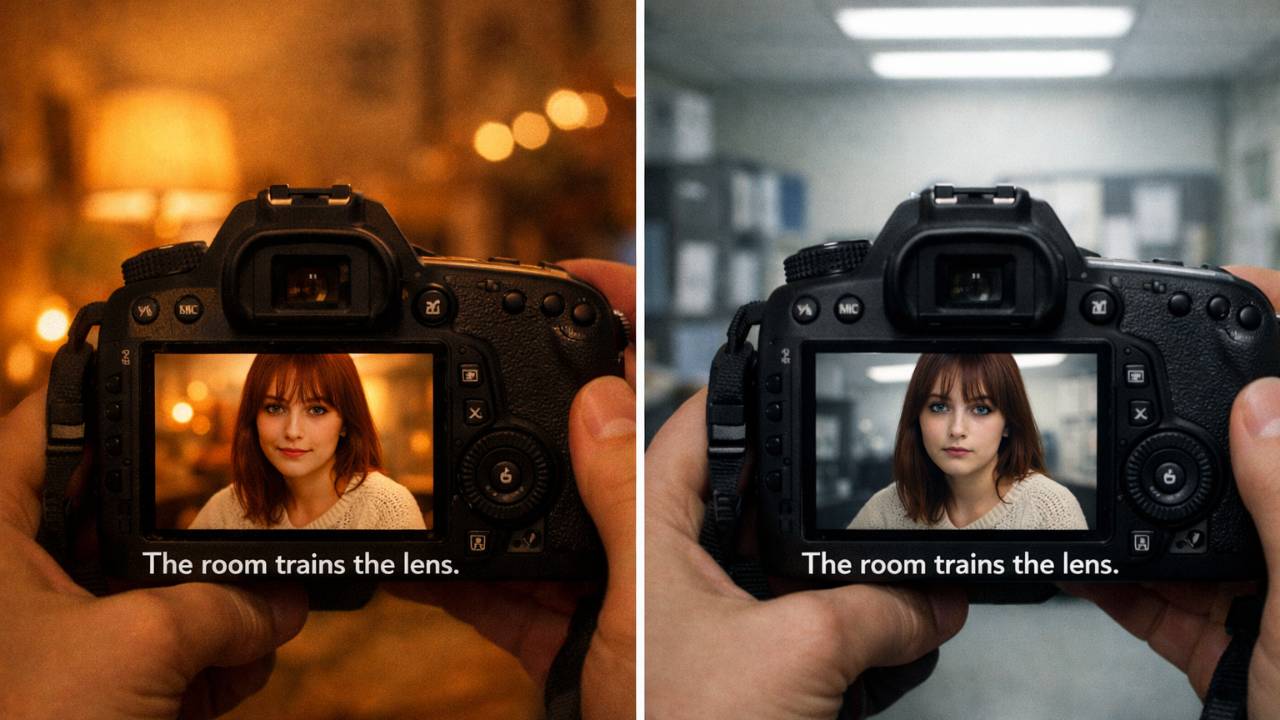
There’s a particular kind of self-blame that sounds like maturity. It sounds like ownership. It sounds like responsibility. It says, “It’s me. I’m the problem. I need to fix my mindset.” And sometimes that is true in the simplest sense: you are the one who can choose your response. But it isn’t always true in the way people mean it. Because what you call “your mindset” is often a learned adaptation to the room you’re in.
In the 3Ps camera model, perception is the lens, perspective is the processing unit, and possibility is the image produced. The model is simple, but it’s not simplistic. It doesn’t pretend you’re a blank slate who can choose any lens at any time. It recognises something more honest: lenses are trained. Processing is trained. And the training is not only personal history. It’s also environment. It’s culture. It’s roles. It’s systems. It’s the repeated conditions you’ve had to operate inside.
This is why two people can be equally capable and yet experience the same day completely differently, not because one is “positive” and the other is “negative,” but because their inner cameras have been trained by different rooms. One person has learned that uncertainty is allowed. Another has learned that uncertainty is punished. One has learned that asking for help is normal. Another has learned that asking for help is a liability. One has learned that mistakes are part of learning. Another has learned that mistakes become evidence.
When a room repeatedly rewards a certain kind of performance, the lens begins to narrow around what will be approved. When a room repeatedly punishes a certain kind of honesty, the processing unit begins to interpret honesty as danger. When a room repeatedly demands speed, the processing unit begins to treat pause as failure. When a room repeatedly ignores boundaries, the lens begins to filter out your own needs because noticing them doesn’t change the outcome. Over time, these aren’t choices you make; they become settings you live from.
This is where people often get confused about “confidence.” They think confidence is a personality trait. But confidence is often a by-product of the room. In a room where you are allowed to learn, your processing unit can stay flexible. In a room where you are allowed to be human, your lens can stay wide. In a room where you are met with curiosity rather than judgement, possibility stays available. In a room where you are constantly evaluated, possibility collapses into survival: don’t be seen, don’t be wrong, don’t be slow, don’t be difficult.
And then, because you are a thoughtful person, you take that collapse and you make it personal. You call it procrastination. You call it self-sabotage. You call it lack of discipline. You call it “my anxiety.” You call it “my imposter syndrome.” You call it “my mindset.” You try to fix yourself while staying in the same room that trained the settings.
This is not an argument for blaming systems and avoiding responsibility. It’s an argument for accuracy. If you want to change what you can see as possible, you need to know what has been shaping your lens and your processing. Otherwise you’ll keep trying to adjust the image while ignoring the lighting.
A room can be a workplace, a family system, a friendship group, a culture, an industry, a leadership style, a set of unspoken rules. It can be a role you’ve lived in for so long you no longer notice it’s a role. It can be the position of being the reliable one, the strong one, the peacemaker, the competent one, the one who doesn’t need much. Roles are rooms too. They come with expectations, and expectations train perception.
When you live in a role long enough, your lens starts to filter for what will keep you safe inside it. Your processing unit starts to interpret deviation as threat. And possibility becomes the image of what you are “allowed” to do, not what you are actually capable of doing.
This is why leaving a room can feel disorienting even when it’s the right choice. Your lens is still trained for the old conditions. Your processing unit is still anticipating the old consequences. You may find yourself bracing for judgement that isn’t coming, explaining yourself when no one asked, shrinking when there is space, performing when you could simply be present. The room has changed, but the settings haven’t caught up yet.
This is also why staying in a room can be exhausting even when nothing is “wrong” on paper. Your system is constantly adapting. Constantly scanning. Constantly predicting. Constantly editing. The effort is invisible because it’s normalised. You don’t call it effort; you call it who you are.
The shift begins when you separate yourself from the setting. Not by denying your responsibility, but by naming what is not yours to carry. Not every tightening is a personal flaw. Not every narrowing is a character issue. Sometimes it is simply a sign that you are in a room that trains the lens toward survival.
When you can see that, something important happens. Your experience becomes less moral. You stop treating your internal responses as proof of weakness. You start treating them as information about the conditions you’re in. And that changes the processing. It loosens the certainty. It widens the frame.
You might still choose to stay in the room. But you stay with your eyes open. You stop expecting yourself to feel free in a place that punishes freedom. You stop demanding ease in a place that rewards strain. You stop calling it a mindset problem when it’s a context problem. And from that clarity, possibility returns—not as fantasy, but as a more accurate image of what is and isn’t available.
Sometimes the possibility is internal: a boundary, a conversation, a decision to stop over-functioning, a refusal to keep performing certainty. Sometimes the possibility is external: a different role, a different team, a different rhythm, a different room. The point isn’t to make a dramatic change. The point is to stop confusing the room’s training with your identity.
In the final post of this series, we’ll bring the whole model together and explore what it means to live with a wider lens without turning it into a project of self-improvement—how to keep perception, perspective, and possibility flexible, especially when life is real and the room is imperfect.
- Watch the YouTube series trailer: Architect of the Human Mind [YouTube link]
- Explore the full webinar journey (a four-part series through the 3Ps):https://www.mindshift202.com/events
- Register for Webinar 2 (April 25, 2026): Understanding Perception:https://us06web.zoom.us/meeting/register/4pMs4z8fRWOW0YtVuWZp7w
- Read the book: Questioning the Walls:https://amzn.eu/d/015xWd2u