Possibility (Image) — What Becomes Visible Next
Mar 14, 2026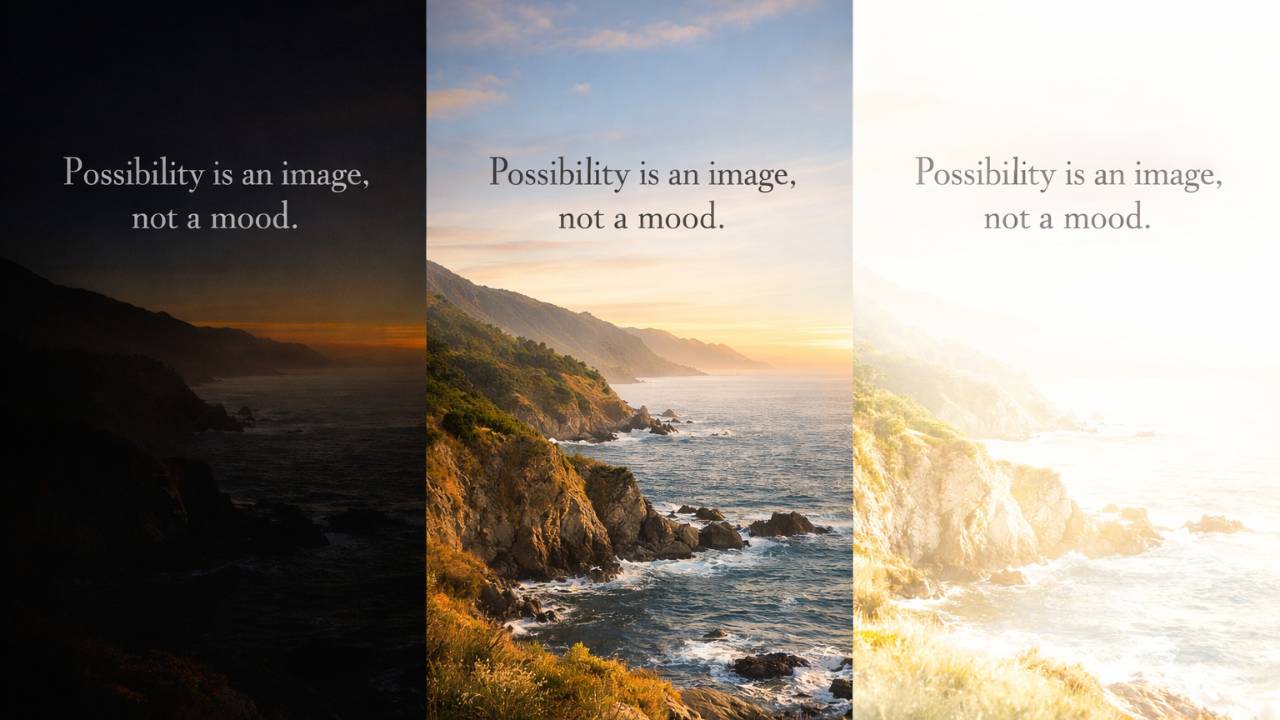
There is a particular kind of stuckness that doesn’t feel like confusion. It feels like certainty. It feels like you’ve looked at the situation carefully and concluded that there are only a few options, and none of them are good. It feels like you’ve done the maths, and the answer is disappointment. It feels like you’ve reached the edge of the map.
This is the moment people often describe with phrases that sound final: “I have no choice.” “It’s too late.” “That won’t work.” “Nothing will change.” “I can’t.”
We tend to treat those phrases as mindset problems, as if the person is being negative or dramatic or resistant. But in the 3Ps camera model, those phrases are often something else. They are descriptions of the image currently being produced.
Perception is the lens. Perspective is the processing unit. Possibility is the image produced.
If the lens is narrow, the processing will be working with limited input. If the processing is rigid, it will produce a familiar meaning from that limited input. And then the image produced—the set of options you can genuinely see—will be small. Not because you lack imagination, but because your system is coherent. It is producing a picture that matches what it has been trained to expect.
This is why possibility is not the same thing as positivity.
Positivity is often an instruction. It’s a demand to feel differently. It can be well-intended, but it tends to land like pressure: “Look on the bright side.” “Be grateful.” “Think better thoughts.”
Possibility is not an instruction. Possibility is a visibility problem. It’s what becomes available to you when the lens widens and the meaning shifts. It’s not about pretending the scene is different. It’s about allowing more of the scene to enter the camera, and allowing more than one meaning to exist long enough for the image to change.
A camera can take the same scene and produce a completely different photograph depending on exposure, focus, and processing. The scene doesn’t have to change for the image to change. Sometimes the image changes because you stop overexposing the threat. Sometimes it changes because you stop underexposing your own capacity. Sometimes it changes because you widen the frame and realise you were cropping out the very information that would have altered your conclusion.
The human version of this is subtle. It often begins with a small act of honesty.
Not the kind of honesty that performs strength, but the kind that admits what is actually happening inside you. The kind that says, “I don’t feel safe here.” Or, “I’m exhausted.” Or, “I’m afraid of being judged.” Or, “I’m carrying more than I’m admitting.” Or, “I want something I’ve been calling unrealistic.”
When you let that information in, the lens widens. And when the lens widens, the processing unit has new input. And when the processing unit has new input, it can produce a different meaning. And when meaning changes, the image changes.
This is why the most powerful shifts are rarely dramatic. They’re often a quiet reorganisation of what you’re willing to see.
Sometimes the shift is letting in a constraint you’ve been minimising. You stop calling your limits laziness. You stop calling your needs “too much.” You stop interpreting your hesitation as failure and start recognising it as information. The meaning changes from “I’m not good enough” to “Something in me is trying to protect me.” The image produced changes from “Push harder” to “Pause, clarify, choose.”
Sometimes the shift is letting in evidence you’ve been filtering out. You notice that you have handled hard things before. You notice that you are not starting from zero. You notice that support exists, even if it isn’t perfect. You notice that one person’s opinion is not the whole room. The meaning changes from “I’m alone” to “I have more resource than I’m acknowledging.” The image produced changes from “Endure” to “Ask, adjust, act.”
Sometimes the shift is letting in complexity. You allow more than one truth to exist at the same time. You stop demanding a single villain and a single explanation. You recognise that you can be disappointed and still be capable. You can be grieving and still be moving. You can be uncertain and still be choosing. The meaning changes from “This is impossible” to “This is hard, and I can still respond.” The image produced changes from “All or nothing” to “One step at a time.”
If you want a gentle way to work with possibility without forcing it, try this question: what would become visible if I let in ten percent more information?
Not a complete overhaul. Not a personality transplant. Ten percent.
Ten percent more honesty about what you’re feeling. Ten percent more acknowledgement of what you need. Ten percent more recognition of what you’ve already survived. Ten percent more willingness to consider that your first interpretation is not the only interpretation.
That ten percent is often enough to change the image.
And when the image changes, action becomes less of a battle. Not because the fear disappears, but because the next step becomes visible. You stop trying to leap across the whole gap and start seeing where your foot can land.
In the next post, we’ll explore what happens when the lens and processing harden into labels—about you, about others, about life—and how those labels quietly reduce possibility without you noticing.
- Watch the YouTube series trailer: Architect of the Human Mind YouTube link
- Explore the full webinar journey (a four-part series through the 3Ps):https://www.mindshift202.com/events
- Register for Webinar 2 (April 25, 2026): Understanding Perception:https://us06web.zoom.us/meeting/register/4pMs4z8fRWOW0YtVuWZp7w
- Read the book: Questioning the Walls:https://amzn.eu/d/015xWd2u
- Book a free 30-minute consultation:https://calendly.com/mindshift202/30-min-free-consultation-call